Saturday, October 27, 2012

Sharing space: Proximity breeds collaboration

ScienceDaily (Oct. 25, 2012) ? A new University of Michigan study shows that when researchers share a building, and especially a floor, the likelihood of forming new collaborations and obtaining funding increases dramatically.

The findings have wide relevance to corporations, as well.

"Our analyses clearly show that there are benefits to co-location," said Jason Owen-Smith, an associate professor of sociology and organizational studies.

Researchers who occupy the same building are 33 percent more likely to form new collaborations than researchers who occupy different buildings, and scientists who occupy the same floor are 57 percent more likely to form new collaborations than investigators who occupy different buildings, he said.

Owen-Smith is the lead author of a report titled "A Tale of Two Buildings: Socio-Spatial Significance in Innovation." The report details the findings of a two-year study funded by the U-M Office of the Vice President for Research, the U-M Institute for Social Research (ISR), and the U-M Medical School.

For the study, the research team conducted surveys of 172 faculty and research staff members in three U-M buildings, and also used administrative data to assess collaboration and physical proximity. The buildings were the North Campus Research Complex (NCRC), the A. Alfred Taubman Biomedical Science Research Building and the Comprehensive Cancer Center.

"One of the truly distinctive features of the University of Michigan is the exceptionally low barrier to doing interdisciplinary research," said Stephen Forrest, U-M vice president for research. "This study gives insights into the benefits that such research brings and how interdisciplinarity, which is now at the forefront of scientific inquiry, is supported by such hubs as the North Campus Research Complex that brings researchers from many different disciplines into contact."

"This study comes at an opportune moment when the NCRC is still an experiment-in-progress of larger scale collaborative research," said David Canter, NCRC executive director. "The conclusions from this study are a reminder that a one-size-fits-all approach is not an optimal approach. Group dynamics and the benefits of chance interactions influence productivity and innovative ideas."

"This kind of rigorous social science research is very much in the ISR tradition," said James S. Jackson, director of ISR. "Similar principles were used by the ISR founders in designing the 1965 ISR building. We invested in this study in order to assist the NCRC but also to inform our decisions about how the new addition to the ISR-Thompson building, now under construction, can maximize interdisciplinary collaborations and success in achieving funding for research from a variety of external sources."

The study, which is the most extensive attempt to date to elucidate the socio-spatial dynamics of successful scientific research collaborations, tests assumptions about proximity and social networks that have stood unexamined for half a century.

One of these assumptions is that passive contacts between inhabitants of a building -- just bumping into people as you go about your daily business -- makes it more likely that you'll share ideas and eventually engage in formal collaborations. This assumption is based on the work of ISR researcher Leon Festinger, who studied the friendships that developed among dormitory residents in the 1950s.

Owen-Smith and colleagues examined the relationship between office and lab proximity and walking patterns, and found that linear distance between offices was less important than overlap in daily walking paths. They developed the concept of zonal overlap as a way to operationalize Festinger's idea of passive contact.

"We looked at how much overlap existed for any two researchers moving between lab space, office space, and the nearest bathroom and elevator," Owen-Smith said. "And we found that net of the distance between their offices, for every 100 feet of zonal overlap, collaborations increased by 20 percent and grant funding increased between 21 and 30 percent."

Owen-Smith and colleagues also found that the likelihood of passive contacts can be more simply assessed by using a measure of "door passing" -- whether one investigator's work path passes by another's office door.

The analysis also showed the research groups studied were more likely to report unscheduled, impromptu encounters rather than scheduled meetings, and that most communication took place face-to-face rather than through electronic means. But this tendency varied among groups.

Other members of the study team are U-M researchers Felichism Kabo, Margaret Levenstein, Richard Price, Gerald Davis, Yongha Hwang and Natalie Cotton Nessler.

Report: http://bit.ly/NCRCReport

Share this story on Facebook, Twitter, and Google:

Other social bookmarking and sharing tools:


Story Source:

The above story is reprinted from materials provided by University of Michigan. The original article was written by Diane Swanbrow.

Note: Materials may be edited for content and length. For further information, please contact the source cited above.


Note: If no author is given, the source is cited instead.

Disclaimer: This article is not intended to provide medical advice, diagnosis or treatment. Views expressed here do not necessarily reflect those of ScienceDaily or its staff.

Source: http://feeds.sciencedaily.com/~r/sciencedaily/living_well/~3/xbnaRjreJgs/121025174631.htm

hoodie hoosiers temperance world bank kim kardashian flour bomb hunger games box office xavier

Monster galaxy may have been stirred up by black-hole mischief

ScienceDaily (Oct. 25, 2012) ? Astronomers using NASA's Hubble Space Telescope have obtained a remarkable new view of a whopper of an elliptical galaxy that may have been puffed up by the actions of one or more black holes in its core.

Spanning a little more than one million light-years, the galaxy is about 10 times the diameter of our Milky Way galaxy. The bloated galaxy is a member of an unusual class of galaxies with a diffuse core filled with a fog of starlight where there would normally be a concentrated peak of light around a central black hole. Viewing the core is like seeing a city with no downtown, just houses sprinkled across a vast landscape.

Astronomers used Hubble's Advanced Camera for Surveys and Wide Field Camera 3 to measure the amount of starlight across the galaxy, dubbed A2261-BCG. The Hubble observations revealed that the galaxy's puffy core, measuring about 10,000 light-years, is the largest yet seen.

A galaxy's core size typically is correlated to the dimensions of its host galaxy, but in this case, the central region is much larger than astronomers would expect for the galaxy's size. In fact, the bloated core is more than three times larger than the center of other very luminous galaxies. Located three billion light-years away, the galaxy is the most massive and brightest galaxy in the Abell 2261 cluster.

Astronomers have proposed two possibilities for the puffy core. One scenario is that a pair of merging black holes gravitationally stirred up and scattered the stars. Another idea is that the merging black holes were ejected from the core. Left without an anchor, the stars began spreading out even more, creating the puffy-looking core.

Previous Hubble observations have revealed that supermassive black holes, weighing millions or billions times more than the Sun, reside at the centers of nearly all galaxies and may play a role in shaping those central regions.

"Expecting to find a black hole in every galaxy is sort of like expecting to find a pit inside a peach," explained astronomer Tod Lauer of the National Optical Astronomy Observatory in Tucson, Ariz., a co-author of the Hubble study. "With this Hubble observation, we cut into the biggest peach and we can't find the pit. We don't know for sure that the black hole is not there, but Hubble shows that there's no concentration of stars in the core."

Team leader Marc Postman of the Space Telescope Science Institute in Baltimore, Md., said the galaxy stood out in the Hubble image. "When I first saw the image of this galaxy, I knew right away it was unusual," Postman explained. "The core was very diffuse and very large. The challenge was then to make sense of all the data, given what we knew from previous Hubble observations, and come up with a plausible explanation for the intriguing nature of this particular galaxy."

The paper describing the results appeared in the Sept. 10 issue of The Astrophysical Journal. The astronomers expected to see a slight cusp of light in the galaxy's center, marking the location of the black hole and attendant stars. Instead, the starlight's intensity remained fairly even across the galaxy.

One possibility for the puffy core may be due to two central black holes orbiting each other. These black holes collectively could have been as massive as several billion suns. Though one of the black holes would be native to the galaxy, a second black hole could have been added from a smaller galaxy that was gobbled up by the massive elliptical.

In this scenario, stars circling in the giant galaxy's center came close to the twin black holes. The stars were then given a gravitational boot out of the core. Each gravitational slingshot robbed the black holes of momentum, moving the pair ever closer together, until finally they merged, forming one supermassive black hole that still resides in the galaxy's center.

Another related possibility is that the black-hole merger created gravity waves, which are ripples in the fabric of space. According to the theory of general relativity, a pair of merging black holes produce ripples of gravity that radiate away. If the black holes are of unequal mass, then some of the energy may radiate more strongly in one direction, producing the equivalent of a rocket thrust. The imbalance of forces would have ejected the merged black hole from the center at speeds of millions of miles an hour, resulting in the rarity of a galaxy without a central black hole. "The black hole is the anchor for the stars," Lauer explained. "If you take it out, all of a sudden you have a lot less mass. The stars don't get held down very well and they expand out, enlarging the core even more."

The team admits that the ejected black-hole scenario may sound far-fetched, "but that's what makes observing the universe so intriguing -- sometimes you find the unexpected," said Postman.

Added Lauer: "This is a system that's interesting enough that it pushes against a lot of questions. We have thought an awful lot about what black holes do. But we haven't been able to test our theories. This is an interesting place where a lot of the ideas we've had can come together and can be tested, fairly exotic ideas about how black holes may interact with each other dynamically and how they would affect the surrounding stellar population."

The team is now conducting follow-up observations with the Very Large Array radio telescope (VLA) in New Mexico. The astronomers expect material falling onto a black hole to emit radio waves, among other types of radiation. They will compare the VLA data with the Hubble images to more precisely pin down the location of the black hole, if it indeed exists.

The Abell 2261 cluster is part of a multi-wavelength survey, led by Postman, called the Cluster Lensing And Supernova survey with Hubble (CLASH). The survey probes the distribution of dark matter in 25 massive galaxy clusters.

The Hubble Space Telescope is a project of international cooperation between NASA and the European Space Agency. NASA's Goddard Space Flight Center in Greenbelt, Md., manages the telescope. The Space Telescope Science Institute (STScI) in Baltimore, Md., conducts Hubble science operations. STScI is operated by the Association of Universities for Research in Astronomy, Inc., in Washington.

Share this story on Facebook, Twitter, and Google:

Other social bookmarking and sharing tools:


Story Source:

The above story is reprinted from materials provided by Space Telescope Science Institute (STScI).

Note: Materials may be edited for content and length. For further information, please contact the source cited above.


Note: If no author is given, the source is cited instead.

Disclaimer: Views expressed in this article do not necessarily reflect those of ScienceDaily or its staff.

Source: http://feeds.sciencedaily.com/~r/sciencedaily/space_time/nasa/~3/0T26sqpssA4/121025130724.htm

316 william daley truffles truffles alabama vs lsu alabama vs lsu bcs championship game

Friday, October 26, 2012

WOW! Women On Writing Blog: Friday Speak Out!; Later Rather than ...

Later Rather than Sooner:

The Saga of a Late-Blooming Author

?

by Rebecca Yount


When I was a callow teen, I had visions of swanning in the literary salons of Paris as wealthy, middle-aged counts made fools of themselves over me.? Though impoverished, I was an intoxicating writer in the tradition of George Sand -- one who stirred men's hearts and incited women's envy.? In my visions, I was eventually rescued from my freezing garret by a bodice-ripping poet.? We married, grew wealthy from our popular books, and lived happily ever after, quaffing champagne and dancing in the Tuilerie gardens on warm summer nights.?

Should we have children, we would see to it that their devoted nanny would be well paid.

Eventually reality bit, bringing me down to earth with a thud.? After I graduated from college, I was forced to admit that there were no attentive counts, middle-aged or otherwise, no bodice-ripping poet and, later on, no devoted nanny to assume the burdens of child-rearing.

On the plus side, I had been fortunate to go through college and graduate school on full scholarships. Predicated on my early training as a concert pianist, I continued as a music major, but a musician who wrote.? Though I love music, writing has always been like oxygen to me.


Following a failed first marriage to a fellow graduate student, I met David and his three school-aged daughters who lived with him.? When David and I married, I instantly became their "mom."? With a simple "I do," those Paris fantasies faded from memory. Yet I loved being "mom," which I regarded as a special honorific title.

And I had something far better than fawning French counts: my husband, who is also a writer.? We vowed to make up for lost time later, rather than wallow in the empty nest syndrome.


David and I both enjoyed successful Washington, D.C. careers, but we still kept our eyes on the ultimate goal: to dedicate our retirement years to writing -- he religious non-fiction, me crime fiction.

But it wasn't easy.

Simply because your children no longer live under your roof does not mean you are totally free from parenting.? And ours seemed to require more than most.

There were times when one or more would move back home; other times when they refused to speak to us; times when they waxed sentimental about their upbringing; and golden instances when they showed signs of becoming strong, independent women -- which is where they are now. Face it: unless a couple can thrive on just one income, setting aside time for creative writing is nearly impossible while working full time, raising kids, fulfilling day-to-day family responsibilities, and cleaning up puppy doo.

I?recall a music conservatory colleague once said to me:? "Becky, don't ever fall in love much less marry.? The grind of a marriage will be the death of your career.? Become the mistress of a wealthy man, and sleep with him whether or not you love him."

Yet even as I scrubbed pet mess from the carpet, I dismissed her advice as baloney.

The longer we live, the more we realize that life goes on.? I have not only raised a family, postponing my literary dreams, but I have endured to become an author while surviving open heart surgery.? It took me two years to become whole again, but by that time I had already written seven books in the Mick Chandra mystery series, eventually publishing the first one as an e-book.? Meanwhile, David is in the process of publishing his 15th book.? So, indeed, we have kept our literary vow to each other.

?Recently we went out to lunch at our favorite neighborhood Italian restaurant.? As we entered, a strikingly handsome young man who works behind the counter flashed me his killer grin, and waved.

"Is he flirting with me?" I asked my husband.

"He always flirts with you," David answered.? "Haven't you noticed?"

"Doesn't he know I'm old enough to be his grandmother?"

David shrugged, "Sure.? He just doesn't care."

Well, I'll be damned!

Kids, if you happen to need us, your father and I will be dancing in the Tuilerie.

????????? ?

?* * *


Rebecca Yount's debut crime novel, A Death in C Minor: A Mick Chandra Mystery, is available in e-book format from Amazon.com; Apple iBookstsore; Barnes & Noble; Sony Reader Store; Kobo; Copia; Baker and Taylor; and eBook Pie. Her second Mick Chandra mystery, The Erlking, will be published in the fall. Her website is www.rebeccayount.com.

?~~~~~~~~~~~~~~~~~~~~~~~~~~~~~~~~~~~~~~~~~~~~
Would you like to participate in Friday "Speak Out!"? Email your short posts (under 500 words) about women and writing to: marcia[at]wow-womenonwriting[dot]com for consideration. We look forward to hearing from you!
~~~~~~~~~~~~~~~~~~~~~~~~~~~~~~~~~~~~~~~~~~~~

Labels: Friday Speak Out, late bloomer, Rebecca Yount, writer inspiration

Source: http://muffin.wow-womenonwriting.com/2012/10/friday-speak-out-later-rather-than.html

portlandia kelly clarkson playoffs empty nest nbc sports bengals vs texans nfl playoffs

Thursday, October 25, 2012

Watch Out for Medical Identity Fraud | Medical Billing | OSI

Medical identity theft means when a person?s name or insurance information is fraudulently used without the person?s knowledge to make false claims for medical services. The victims often end up losing all their healthcare benefits.

It is estimated that up to 1.5 million Americans are victims of medical fraud every year, and that the average cost to restore identity after medical identity theft is about $20,160. The average price of a new car is $28,400!

Medical identity theft is difficult to prevent, detect and resolve. People may discover that they have been duped only after a long time, sometimes two years after the fraud takes place. Issues the victims experience include

  • Loss of credit
  • Higher health care premiums
  • Loss of all health care coverage benefits
  • Expenses on legal procedures

It is difficult to completely avoid medical identity theft, but the Federal Trade Commission (FTC) says that there are some things people can do to reduce the risks.

  • Be careful while sharing your medical and health insurance information.
  • Read and understand ?Explanation of Benefits? (EOB) forms properly.
  • Verify the source before you share the information. Medical identity thieves can approach you pretending to be employees of insurance companies or doctors? offices. They trick you into revealing your medical identity details and use the information to submit fake claims for reimbursement.
  • You should order copy of your credit reports every year. This will provide details of your accounts and you can check whether bills are paid promptly.

If you are a victim of medical identity theft, you can use your rights under HIPAA to correct any errors in your medical billing records.

Physicians should also watch out for such medical billing fraud as they may inadvertently bill the wrong patient. It is important for the physician and their staff to be vigilant and ensure that they don?t unknowingly get involved in fraudulent matters.

Source: http://www.outsourcestrategies.com/blog/2012/10/watch-out-medical-identity-fraud.html

2012 grammys foo fighters nikki minaj grammys album of the year grammy red carpet grammy award winners

Something Natural...Aromatherapy To Enhance Everyday Living 10 ...

  • Loading

    We have Grammy award winning record producer Mr bangladesh for a special 2 hour special promoting his new artist and music career

  • Marx & Julie chat with British filmmaker Chris Stone, the writer & director of the Victorian vampire web series turned feature film called Blood and Bone China. As if that wasn't enough, we also speak to our featured indie music artist of the week, Birthrite.

  • Native American Movement founder Russell Means was laid to rest yesterday at his home on Pine Ridge Reservation, South Dakota. He is remembered with comments, stories, and prayers.

  • Lori Saitz is a nationally recognized expert in using gratitude to boost client retention and increase referral business. She is the founder of Zen Rabbit, which is a concierge type company specializing in helping business professionals ?multiply profits

  • Gus Speth, author of AMERICA THE POSSIBLE,shares his vision of comprehensive and deep change rooted in a political economy that sustains people, communities and nature. Long time Washington insider, he now is part of the protest movement.

  • One of Radio One?s top DJs, DJ Kayotik will be on with us to talk about career, current mixtape KAYOTIK KHRONIKLES VOL. 1, and youth organization.

  • Queen Afua, has been an expert in Wholisitc Health, a lecturer/author for 40 years. She'll discuss the 21 Detoxification Process & the work she's doing in Detroit for the next year. Kilindi Iyi, world renowned lecturer and Master of The African Martial Art

  • Mothyna James-Brightful-Global freedoms and empowerment campaign for domestic violence awareness-Heal a Woman to Heal a Nation. Dawn-Marie Hanrahan is a #1 Bestselling Author, TranSpirational Speaker and Spiritual Leader, who travels the world educating others

  • Health & Fitness is on tap when International Fitness Model Charles Flanagan and IFBB Pro Fitness competitor Donna Jones from Australia tackle everything from nutrition & exercise to the psychology of living well, Speaking to callers LIVE

  • Stacey Monroe welcomes Rico and J-Rod from the group Recognition to E! GEMZ! Radio to speak about their music career and life. How did they two become Recognition? What did they both give up in order to pursue there music career? Tune in to see what they have

  • Big Blend Radio talks with outdoorsman and naturalist Jay Erskine Leutze about his acclaimed book STAND UP THAT MOUNTAIN: The Battle to Save One Small Community in the Wilderness Along the Appalachian Trail.

  • Teen Hosts McMillen, Janae, Jackie, Jessica, and Salwa discuss common sex myths. Our guests, Crystal Collette and Caitlin Mcardle from Planned Parenthood, are here to give us the facts.

  • This week on the BIG show, host Tim Gordon will talk with writer/director Matthew Cherry about his upcoming drama, The Last Fall. The semi-autobiographical tale tell the story of an NFL journeyman who struggles to deal with life's after the game.

  • Super Role Model, Valerie Jeannis, heralded as ?the Catalyst?, joins the Feminine Soul Radio show and talks about her new book I Am Beautiful: Changing the Way You See Yourself. Valerie will inspire you to say yes to your life and take action on your dreams.

  • In the dark, driving tasks like looking at other vehicles ahead and reading road signs are more difficult for some drivers. With the end of daylight savings only eight days away, tune into Healthy Vision? with Dr. Val Jones to learn how to take better care of your eyes ? and your car ? to improve your nighttime driving.

  • Legendary singer, Tony Bennett kicks off our new Storytellers series with a special live interview. Join hosts Eric Olsen (@amhaunted) of America?s Most Haunted and Chitra Agrawal, BlogTalkRadio?s own Director of Marketing, for the premiere.

  • The Phantom Zone Radio Show welcomes actor, screenwriter, and film editor, Camden Toy. He is best known as a character actor in the series, Buffy The Vampire Slayer and it's spinoff series, Angel.

  • Join Weigh In Sports as they talk to the CEO of BCS.net Magazine Robin Bayless as they go over the new BCS standings, the founding of the magazine in such a competitive market, the writers and much more.

  • Source: http://www.blogtalkradio.com/cherylsmith/2012/10/25/cheryls-world

    barry sanders barry sanders john scott jimmie johnson juan pablo montoya crash chardon high school shooting mark martin

    Pumpkin Inferno at Upper Canada Village - Oct 5-31, 2012

    Halloween 2012 ? Posted by OttawaStart on October 31, 2012
    RSS Link OttawaStart Community News on Twitter Subscribe to OttawaStart Community News by Email

    ?From Thanksgiving weekend through the end of October of 2012, a Hallowe?en experience will unfold unlike any other in Canada.

    Come and stroll through an all-new, hauntingly beautiful and spellbinding outdoor exhibit of thousands of hand-carved pumpkins, set against a stirring night-time backdrop just inside the gates of historic Upper Canada Village.? Marvel at this eclectic display of scenes from exotic places and historic ages, meet up with forest animals and sea-born creatures, see story book heroes, mythical characters,? cultural icons and more .... all carved from pumpkins!

    This mesmerizing installation of artist-inspired, glowing pumpkins is a not-to-be-missed event for ALL ages.

    ?

    DATES AND HOURS OF OPERATION

    Friday to Monday, October? 5, 6, 7, 8
    Friday to Sunday, October? 12, 13, 14
    Thursday to Sunday, October 18, 19, 20, 21
    Thursday to Sunday, October 25, 26, 27, 28
    Hallowe?en ? Wednesday, October 31.

    6:30 p.m. to 9:30 p.m.

    ?

    ADMISSION (tax not included)
    $10??????? Adult (13 and over)
    $7????????? Senior (65 and over) / Youth (6 - 12)
    FREE???Child (5 and under)

    Click here for a big list of Halloween events in Ottawa...


    ?

    Search our news archive

    ?

    More news


    Subscribe to OttawaStart Community News

  • Subscribe via RSS RSS Link
  • Subscribe via Twitter OttawaStart Community News on Twitter
  • Subscribe via email Subscribe to OttawaStart Community News by Email
  • ?

    Source: http://feedproxy.google.com/~r/ottawastart/news/~3/5G6NpIGZoJY/17979.php

    Pussy Riot National Hurricane Center Zeek Rewards elvis presley elvis presley vanessa bryant vanessa bryant

    Wednesday, October 24, 2012

    Ad Agencies Hate Lance Armstrong - Business Insider

    Armstrong: not welcome on Madison Avenue

    In hindsight, Lance Armstrong's sponsors took way too long to terminate their relationships with the athlete, according to some advertising executives.

    As of today, all of Armstrong's sponsors have dropped him from their rosters after the USADA released evidence that the cyclist used performance enhancing drugs for years.

    It sounds trite, at first. After all, Armstrong has done way more damage to himself and the sport of cycling than he has to advertising. But remember that advertising is the industry that has poured millions into Armstrong's brands -- his race team, his Livestrong charity, and himself. They invested serious cash in Armstrong in just the same way as if he were a stock or a bond. Armstrong has lost $30 million in the fiasco. Put another way, his endorsers have wasted $30 million on him.

    And now, with Armstrong finally proven guilty, some execs are breaking ranks and venting their fury at what Armstrong has done to the branding and sponsorship business. It is extremely unusual for ad execs to talk frankly about their rivals and clients like this.

    Amir Kassaei, the chief creative officer of DDB Worldwide told us, "In the case of Nike and Lance Armstrong, Nike was late in their decision to terminate that relationship considering the illegal drug accusations that were constantly in the news. These allegations against Lance are completely off base from what Nike's brand platform is ? authentic athletic performance."

    A number of sponsors expressed sadness and hopefulness for the future, but these advertisers are just mad.

    "Dropping [Armstrong] was a no-brainer. He lied to the public. He lied to investigators. And he lied to his partners at Nike," said Matt MacDonald, co-chief creative officer of JWT New York, "I feel like he even lied to me personally when I attended his rally in Austin after winning his first Tour de France. So maybe I'm a little bitter."

    This is because Armstrong was more than just a celebrity, he represented an entire community of professional cyclists and their fans.

    "Contrary to the cases involving Tiger Woods and Michael Vick, Lance's role went far beyond himself and affected the sport of cycling by influencing other athletes and undermining the cycling community," explained Sharon Napier, CEO of Partners + Napier, A Project:WorldWide Agency. She added, "The simplest definition of a brand is 'a promise made and a promise kept.' As overwhelming evidence suggests, Lance didn?t keep his promise to the cycling community. He not only hurt the sport, he damaged the Livestrong Foundation and brand. I believe Nike?s decision to continue their support of the Livestrong Foundation and those affected by cancer is a great example of a brand really living their values."

    MacDonald does acknowledge that knowing when a brand ambassador has gone too far is not always obvious: "In general, we advise our clients to walk away from any endorser whose personal life and actions overwhelm the positive attributes they bring to the brand."?

    Related:

    Source: http://www.businessinsider.com/ad-agencies-hate-lance-armstrong-2012-10

    serrano staten island chuck dr jekyll and mr hyde edwin jackson punksatony phil trump 2012 groundhog day

    Beltline's finance director steps down - Creative Loafing Atlanta

    Source: http://clatl.com/freshloaf/archives/2012/10/23/beltlines-finance-director-steps-down

    ghost rider spirit of vengeance hornets prince johan friso windows 8 logo anguilla gone with the wind michael jordan

    India gearing up for polio-free country tag

    Having made unprecedented progress in polio eradication, India [ Images ] is now gearing up to be declared polio free by 2014 by guarding itself against the import of polio virus from neighbouring countries and by boosting routine immunisation.

    Earlier this year, the World Health Organisation had removed India from the list of polio-endemic countries. If no fresh case is reported till 2014, the country will be declared polio free.

    "However, the risk of polio persists as long as poliovirus transmission continues anywhere in the world," says Dr Ajay Khera, deputy commissioner at the Union ministry of health and family welfare, while pointing out that among the remaining polio endemic countries of Pakistan, Afghanistan and Nigeria, two of them are with close proximity to India.

    Regular Polio immunisation is being carried out at five border points along the Indo-Pak border, at Baramulla and Poonch in Jammu and Kashmir [ Images ], Attari and Wagah in Punjab [ Images ] and Munabo in Rajasthan [ Images ].

    To raise public awareness on the ravages of polio and garner support for eradication efforts, World Polio Day will be observed tomorrow across the globe.

    The health ministry, along with its partners in World Health Organisation (WHO), Unicef and Rotary International, are taking special efforts across the country, particularly in the high-risk areas and among high-risk groups for polio -- such as migrant and mobile populations -- to ensure they are reached with polio vaccines.

    The government has an Emergency Preparedness and Response Plan in place and is totally geared to roll out a rapid and intense response to any case of poliovirus importation anywhere in the country, officials said.

    With its 6,500-member strong Social Mobilisation Network (SMNet) working with the most underserved communities and in the highest risk areas of Uttar Pradesh [ Images ] and Bihar, Unicef is focusing on strengthening routine immunisation.

    "One of the biggest risks to the programme today is complacency. We need to ensure that the programme continues to be of the highest quality, to maximise childhood immunity to polio across the country and minimise the threat of virus importation," says Lieven Desomer, Chief Polio, Unicef India.

    The SMNet community mobilisers are engaged in door-to-door counselling, community meetings as well as tracking and counselling of the families who have dropped out of routine immunisation.

    "We continue to counsel parents on the need to protect their children against polio and address associated risk factors such as hygiene, sanitation, nutrition and diarrhea management," says the officer.

    Siddhartha S Bose from the Indian National Polio Plus Committee run by Rotary International says, "We need strong vigilance on the borders so that the virus doesn't return to India. The threat is still there".

    India has not reported any case of polio for over a-year -and-a-half, after an 18-month-old girl was crippled by polio in West Bengal's [ Images ] Howrah district in January 2011.

    ?

    ? Copyright 2012 PTI. All rights reserved. Republication or redistribution of PTI content, including by framing or similar means, is expressly prohibited without the prior written consent.

    Source: http://www.rediff.com/news/report/india-gearing-up-for-polio-free-country-tag/20121023.htm

    Tony Scott UFC 151 empire state building Todd Akin Hurricane prince harry hunger games

    Tuesday, October 23, 2012

    BBC has questions to answer over Savile scandal: Cameron

    {ttle}

    {cptn}","template_name":"ss_thmb_play_ttle","i18n":{"end_of_gallery_header":"End of Gallery","end_of_gallery_next":"View Again"},"metadata":{"pagination":"{firstVisible} - {lastVisible} of {numItems}","ult":{"spaceid":"2145892301","sec":""}}},{"id": "hcm-carousel-1287408922", "dataManager": C.dmgr, "mediator": C.mdtr, "group_name":"hcm-carousel-1287408922", "track_item_selected":1,"tracking":{ "spaceid" : "2145892301", "events" : { "click" : { "any" : { "yui-carousel-prev" : { "node" : "a", "data" : {"sec":"HCMOL on article right rail","slk":"prev","itc":"1" }, "bubbles" : true, "test": function(params){ var carousel = params.obj.getCarousel(); var pages = carousel._pages; // if same page, don't beacon if(("_ult_current_page" in carousel) && carousel._ult_current_page==pages.cur) return false; // keep track of current position within this closure carousel._ult_current_page = pages.cur; return true; } }, "yui-carousel-next" : { "node" : "a", "data" : {"sec":"HCMOL on article right rail","slk":"next","itc":"1" }, "bubbles" : true, "test": function(params){ var carousel = params.obj.getCarousel(); var pages = carousel._pages; // no more pages, don't beacon again // if same page, don't beacon if(("_ult_current_page" in carousel) && carousel._ult_current_page==pages.cur) return false; // keep track of current position within this closure carousel._ult_current_page = pages.cur; return true; } } } } } } })); }); Y.later(10, this, function() {(function() { try{ if (Math.floor(Math.random()*10) == 1) { var loc = window.location, decoded = decodeURI(loc.pathname), encoded = encodeURI(decoded), uri = loc.protocol + "//" + loc.host + encoded + ((loc.search.length > 0) ? loc.search + '&' : '?') + "_cacheable=1", xmlhttp; if (window.XMLHttpRequest) xmlhttp = new XMLHttpRequest(); else xmlhttp = new ActiveXObject("Microsoft.XMLHTTP"); xmlhttp.open("GET",uri,true); xmlhttp.send(); } }catch(e){} })(); }); Y.later(10, this, function() {Y.namespace("Media").ywaSettings = '"projectId": "10001256862979", "documentName": "", "documentGroup": "", "ywaColo" : "vscale3", "spaceId" : "2145892301" ,"customFields" : { "12" : "classic", "13" : "story" }'; Y.Media.YWA.init(Y.namespace("Media").ywaSettings); }); Y.later(10, this, function() {if(document.onclick===YAHOO.Media.PreventDefaultHandler.newClick){document.onclick=YAHOO.Media.PreventDefaultHandler.oldClick;} }); }); });

    Iran's Ahmadinejad denied visit to Evin prison

    DUBAI (Reuters) - Iran's judiciary has blocked a request by President Mahmoud Ahmadinejad to visit Tehran's Evin prison where a top presidential aide is being held, a further sign of his waning influence in a last year in office.

    Ali Akbar Javanfekr, Ahmadinejad's press advisor and head of the country's state news agency IRNA, was sent to Evin in September to serve a six-month sentence for publishing an article deemed offensive to public decency.

    He was also convicted of insulting Iranian Supreme Leader Ayatollah Ali Khamenei on his personal website, though it is unclear how or when this happened.

    Ahmadinejad's request to visit Evin, made public this month, was seen by Iranian media and commentators as linked to Javanfekr's detention although there has been no official confirmation this was the case.

    The judiciary turned down the request on Sunday, saying it was not in the best interests of the country as it faces an economic crisis which parliamentary rivals blame as much on mismanagement by Ahmadinejad's administration as Western sanctions.

    "We must pay attention to major issues," prosecutor general Gholam-Hossein Mohseni-Ejei said on Sunday according to the Mehr news agency. "Visiting a prison in these circumstances is a minor issue."

    He added: "If we have in mind the best interests of the nation, a (prison) visit in these circumstances is not appropriate."

    Ahmadinejad has seen his influence wane within Iran's factionalized political structure following a public spat with Khamenei in 2011.

    The feud between the Iran's elected and unelected leaders erupted in public last year after Khamenei, who holds ultimate power, reinstated intelligence minister Heydar Moslehi, who Ahmadinejad had sacked.

    Conservative rivals of Ahmadinejad in parliament say his administration has mishandled a currency crisis and other economic fallout from the sanctions levied against Iran's disputed nuclear program.

    According to Iranian law Ahmadinejad is not allowed to run for a third term in the June 2013 presidential elections.

    (Reporting By Yeganeh Torbati; editing by Patrick Graham)

    Source: http://news.yahoo.com/irans-ahmadinejad-denied-visit-evin-prison-072834915.html

    masters golf tournament the replacements how to hard boil eggs new nfl uniforms easter derbyshire the matrix

    Jake Chessum Interview

    Jake Chessum is a photographer you will find near the top of all photo editor lists and that?s why I?m so excited he will be joining me Fri, Oct 26, 2012 from 1:30 PM to 3:30 PM for a panel discussion on ?Making a Career in Editorial Photography? at the Photo Plus Expo in NYC. I had the opportunity recently to sit down with him at his studio and discuss his career.

    APE: Let?s start at the beginning. When did you first get interested in photography?

    Jake Chessum: I was 17 years old and I went to see an exhibition by the British photographer John French. I clearly remember going home and saying to my mum, ?I want to a photographer.? I had been taking my own pictures for about a year before that, but this was the first time I clearly remember deciding on a career.

    But before that, my dad worked for this company that would hire photographers and he used to work with this guy, Chris Morris. This guy always seemed glamorous. He had a sports car and he lived in Holland Park, which is super fancy West London.

    Because of this my dad had access to photography. He?d always had an old Pentax 35mm camera when we went on family holidays, and he would shoot black and white and come home with enlarged 16 by 20 contact sheets and massive fiber based prints of all our holiday snaps and our personal photos. This was from when I was about 6 or 7 years old onwards.

    APE: You?re kidding. He would make enlarged contact sheets? Why would he do that?

    Jake: He enjoyed taking pictures, and because he could. He worked for Wates, which was a home building company and they had a photography budget to shoot an internal magazine, and pictures of the new developments.

    APE: So, he?d take in the vacation film as well?

    Jake: They were really good photographs. And it was mostly black and white. That?s what probably sparked it. I liked to see prints and see photography.

    At the time I was at an all boys private school in Croydon where art wasn?t considered a career path, but when I was 16 I moved to another school where art education was taken more seriously. There were a couple of art teachers there who were really enthusiastic and really encouraging and made it seem like it was a real proposition to make a career out of it. They?d been to art school in Central London.

    APE: So, you decided to go to art school in London?

    Jake: There was an art school in our town but it was rubbish so we all realized that we didn?t want to go there, so had to put a terrible portfolio in or concoct an excuse why you had to go to one of the London art schools.

    APE: How does that work? I don?t understand. Do you automatically get to go to school?

    Jake: No your portfolio had to be accepted.

    APE: So you would give the local school a crap portfolio?

    Jake: That is what the smart people did but I went by the rules. I put in a good portfolio and got in but then I wrote to the local council and explained that they didn?t have a good textile department and I wanted to be a textile designer and this school was not going to give me the opportunities. Miraculously they believed me, as it was a lie. So I was able to attend The Central School of Art and Design (now Central St. Martins) for my Foundation Course.

    APE: Did you know that you had a talent for photography? Was it evident then?

    Jake: I guess. A decent part of my portfolio was photography. I did this project where I went day and night taking photographs on Chelsea Bridge, and I showed this work to my tutor and she told me, it?s very difficult to define what makes a good photograph, but you know what it is, you can do it. And I thought wow, really? [laughs]

    That was ?86 and I remember I started buying The Face and Vogue when I was 16, because I was really into magazine design. So, when it came to choosing a degree, I?d looked at photography courses, but they were all kind of ridiculous, because to make it a valid educational qualification, they had to give it this kind of bogus scientific basis or some kind of quantifiable, gradable quality.

    It was all based on technique and technical stuff, and I knew I wasn?t particularly interested in that side of it. I was more interested in the images, making the images. I didn?t really care to be graded on black-and-white printing or that aspect of it. So, I thought the next best thing was the graphic design course at St. Martin?s which had a photography unit, so that?s what I went for.

    APE: So, you went into graphic design.

    Jake: Yes, I did a graphic design degree kind of knowing that I wanted to do photography. But the great thing about St. Martin?s at that time was it was kind of a free-for-all, do you know what I mean? After the first year I was really unhappy because I was following the course, trying to do the projects and failing miserably. But by the second year a couple of friends and I worked out that if we just went down to the basement darkroom and printed, no one would bother us.

    APE: [laughs]

    Jake: I mean, it was very vague. They would set a project, and you would either do it or not, and I decided not to [laughs].

    APE: But, if you didn?t do the project didn?t you fail?

    Jake: You didn?t really get into trouble. I don?t know how I didn?t get into trouble, really. But everything was judged on the end of year show, and I always had a lot of work to show. At my second year show I put up photographs and some type designs. One of my fellow students, Graham Wood (now of Tomato) told me he thought I should ditch the typography and stick to photography. Good advice.

    But it was definitely laissez-faire. And I remember people thought that I didn?t do any work all year, but it was because they never saw me because I was in the darkroom all year. I was just standing in the darkroom after taking pictures of whatever on the street, or portraits. I cast a few people in the school that I?d seen around just to try and just get together a portfolio. I also did tests with models as St. Martin?s was in Covent Garden where all the model agencies were.

    APE: So school gave you an opportunity to just take pictures?

    Jake: It was an amazing time. Now I?ll get calls from people once in awhile saying ?What should I do, Should I stay in college or should I get a job?? It?s difficult to advise them to do what I did, because college was free then. I left college in London with a debt of 800 pounds. It?s nothing. So for me?

    APE: And three years of taking pictures?

    Jake: Yeah, three years of freedom and it was free. It was paid for by the government.

    APE: Amazing. That still happens?

    Jake: No, now I think you have to pay 9,000 pounds a year. But even that?s nothing compared to here in America.

    APE: Do they produce a lot of photographers, is your country just swarming with photographers?

    Jake: No, no, and again, it was so long ago, this is 1990 and there were a lot of magazines, like the Face, Arena, ID and Blitz. They had no budget and they attracted up and coming people who were willing to work for pictures because they gave you creative freedom.

    APE: Right.

    Jake: It was a great era. There we so many photographers starting out at that time who are still really successful: Craig McDean, Richard Burbridge, Glen Luchford, David Sims, Juergen Teller, the late Corrine Day. It was an amazing era to be a young photographer shooting in London. It really was a very creative period.

    APE: Tell me about your first job?

    Jake: I put together a degree show in June of 1990 but I had worked for a few people before that because St. Martin?s was in the center of London and there were a lot of people who had studied there and had good jobs so they would come back and throw a couple of bones to the kids at school.

    So I did a few shoots for short-lived magazines. Actually, the day the degree show opened, Phil Bicker gave me my first ?real? job for The Face, which was to take a train to Macclesfield, which is a kind of grim, northern town and take a picture of a young rapper. I had to get up there as early as possible, shoot the picture and come back to London for the opening of the degree show. I went on my own with a borrowed Pentax 6?7, a 90mm lens, a 135mm lens, a homemade reflector and a few rolls of tri-x.

    And The Face actually wrote a piece about me. They did a double-page spread about six graduates from London art schools and they featured me. Which at the time I was completely blase about. Which is funny because now I?d be super-psyched

    APE: So, that was your first job. You graduated from school, got a job and got written up.

    Jake: And then I?d go and see people with my portfolio, and I got a few calls from that for jobs. And basically, for the first two years I was green as hell. I didn?t know what I was doing. I didn?t know how to run a business, we never had any lessons on running a business, invoicing, nothing.

    APE: You just spent all your time in the darkroom.

    Jake: Yes, so suddenly you?re like, shit, what do I do? But the amazing thing was, suddenly someone?s saying, oh, can you do this job, it?s 400 pounds a day. That?s still decent money, do you know what I mean?

    APE: That was a ton of money for you at the time.

    Jake: Then I scored my first ad job off the back of my show, which is bizarre. I got a job for Neutrogena shooting four ads.

    APE: Why would they pick somebody who just graduated?

    Jake: God bless them, I?ve got no idea. I mean, I think they wanted to use a young photographer. They?d got in a load of books and they got me to do it, and paid me 1500 pounds a day.

    APE: Was your work that good back then? If you looked at it now, would you think, OK, there?s some good stuff in there?

    Jake: Yes, there are some good pictures. But I didn?t know what I was doing?

    APE: As far as running a business?

    Jake: Yes, exactly. And running a set, dealing with hair and make up artists, stylists, clients?

    APE: You just knew the picture part.

    Jake: I?d done a bunch of nudes and portraits of friends, and they were all natural light. But, Jesus. [laughs] I wouldn?t have hired me. I was 23 and green as hell, but I was very enthusiastic.

    APE: That was big money.

    Jake: Yes, it was 1500 pounds a day for four days at a time when I?d never earned anything. But the funny thing was, they kept saying, we want to do really natural girls, we don?t want these supermodels. So, we did the casting and we cast a 16 year old Kate Moss.

    APE: [laughs] No way. That was your first ad job? Kate Moss. Ok, I think there?s some stars aligned for you.

    Jake: Yes, maybe.

    APE: Something?s going on.

    Jake: She was so amazing, she was so charismatic and beautiful. And I remember the casting, because I?d met her like, three or four times. She lived in Croydon where I lived, so I?d bump into her on the train once in a while, although I?m absolutely certain she has no recollection of this. I remember talking to her on the tube platform at Victoria Station one day, I bumped into her and she said, ?I?m sick of this, I?m going to give up, I?m getting nowhere,? which is deeply ironic.

    So, at the casting, she came in and saw me and said hello and came over and kissed me on the cheek. And the art director?s like, ?Who?s that girl, how do you know that girl? She?s amazing, how do you know her?? She was obviously something pretty amazing.

    So I did that and I was a living at home so I had no rent to pay and I think in my first year I made 25,000 quid, so for the first year out of college, that?s not bad 20 years ago.

    APE: What?s that in US dollars?

    Jake: $40,000.00

    Another big break was in December of 1990. I got a call from Dylan Jones who was the editor of Arena. He said, ?Do you want to shoot Gary Oldman?? I was like ?yeah? until I found out it was at a restaurant and it was lunch with Gary Oldman. He would be sitting there eating his lunch being interviewed.

    I said, ?Oh, all right, yeah, yeah.? It?s tough. At a restaurant. I didn?t know how to use light or anything. I had no system. So I turned up at this job to meet Gary at the restaurant.

    I was first there, and when he walked in I introduced myself: ?Hey Gary, I?m Jake. I?m here to take your picture.? He said, ?What do you mean? They didn?t tell me there was a photographer. I was like, ?Oh, OK.? I said, ?OK, I totally understand. Can I just tell you something? I just left college three months ago. This is one of my first jobs, and I know that they told me they want to put you on the cover, but they don?t have a cover shoot. Will you do a cover shoot with me?? He said, ?Yeah, call me next week. Come to my flat and we?ll do it. I?ll give you half an hour.?

    APE: You talked him into it?

    Jake: Yeah. I met him in Chelsea. It was a shitty day. I took my friend, not an assistant and we put a piece of white cardboard up on a children?s playground in Chelsea. No groomer, no stylist, shot a head shot of Gary Oldman, and they put it on the cover. [laughs]

    APE: Amazing.

    Jake: That was a huge deal for me, first of all that I talked him into it, second that he was an actor who I thought was fantastic. I loved ?Sid and Nancy? and ?Prick Up Your Ears? and it was the cover of Arena. The main magazines I wanted to work for at the time were Face and Arena.

    APE: That?s great. You never assisted anyone?

    Jake: I did one day with Kevin Davies. He said to me, ?Why do you want to do this? You are already shooting.? I remember, I assisted him on a test and I had to go to do a job in the afternoon so I had to leave to shoot Gabriel Byrne [laughs]. But he was cool about it.

    APE: One day of assisting your entire career?

    Jake: Yeah, that was it. I went to see another photographer who was well known and I remember, I said, can I assist you? He said, ?Fuck off, you?re a rival now.? Those are his exact words to me.

    APE: [laughs]

    Jake: I?d done one job so I didn?t consider myself a rival. I thought he was amazing.

    APE: You?ve probably met a lot of assistants and young aspiring photographers who go to school here. It?s completely different.

    Jake: I dread to think what it?s like now to try and start. It must be so hard.

    APE: Do you feel like back then the industry was tighter?

    Jake: London was kind of small. I think there were a group of magazines that were looking at younger photographers and I think the fact that there weren?t that many photo studios and everybody used to shoot at Click Studios meant there was a sort of camaraderie.

    I remember hanging out in the office at Click and Glen Luchford was there and he said, ?I sent in one print.? and I was like ?What do you mean one print?? I would send in the whole shoot. I had no idea that you should send in an edit. I was completely clueless. I thought, ?What are you talking about? That?s ridiculous. How arrogant to suppose that you know more than the art director?. But of course he was right.

    APE: So you just picked up little pieces here and there. How to run your business and how to do an edit?

    Jake: Yeah, it was a very gradual process. I think in those first few years I was very fortunate that I got to shoot a lot of people who were about to become very famous. Quentin Tarantino, Beck, kd lang, Tricky, for example. So I quite quickly had a celebrity book going. Being trusted to shoot big names, and getting publicist approval is a huge hurdle to jump for any new photographer. But there was also a time where I would shoot anything that was offered to me. I was shooting some terrible pictures, and taking terrible commissions. Because first of all, I didn?t know how to say no. I didn?t have a cell phone and there was no email. If they called you and you picked up the phone?

    APE: You had to have an excuse if you didn?t want to shoot.

    Jake: Yeah, it was really hard to say no, plus the money was good. I was happy to be asked to do stuff. After a couple of years, I had a conversation with somebody at Arena. I think it was one of the fashion editors I worked with on a job. She?s said, ?Why are you doing all these shit jobs, because you?re watering down what you?re good at.?

    Then I got to know Grant Scott, who was a great mentor to me, and the Art Director at British Elle. I went into see him after I?d been working maybe two years. He said, ?You?re at the point now you?ve got to decide. Do you want to be a working photographer or a good photographer? A working photographer does what they?re offered, a good photographer picks and chooses.?

    That was a real big moment for me, because I was only 25.

    APE: Then you start turning down jobs?

    Jake: Literally that week, I had accepted a job shooting some corny feature for a Women?s magazine, about women who have affairs with their personal trainers or something. The guy called me to talk about the shoot and I said, ?Look, I can?t do that job for you.? I had to make a decision and not do this shit anymore, and stick to it. So I said no to that. It was the end of 1992. The economy went to shit and literally I didn?t work for six months. [laughs]

    APE: Oh my God. Did you freak out?

    Jake: Yeah, I was really freaked out.

    APE: You were thinking that was horrible advice.

    Jake: No, I thought it was good advice but I was still freaking out.

    APE: You didn?t know if you could make a career turning down bad jobs.

    Jake: Yeah, yeah.

    APE: So what happened? Six months, hardly any work?

    Jake: I was making like three, four hundred a month.

    APE: Still living at home?

    Jake: Yeah, I was fortunate to be still living at home, thank God. Gradually it started to pick up again and I found new routes into different clients, being a bit more picky.

    Then Lee Swillingham became art director at The Face and he started to call me fairly regularly to shoot portraits.

    In late 93 he called and said, ?Do you want to go to the worst area of Los Angeles to shoot Ice Cube?? ?Yes.? [laughs] I had been to America twice on holiday. Suddenly I was flying to LA to shoot Ice Cube. I went with the writer to South Central and we had a 20-minute shoot with Ice Cube on the street.

    APE: How was it?

    Jake: It was incredible. I?d never been to L.A. and we sat with him and he kind of started doing the hip-hop gangster poses. And I said, oh no, I don?t really want to do that, can we do something a bit more?And he went, ?you mean, a bit more reflective.? I was like, yes, exactly. So, he sat on the curb and he just hung out.

    APE: And you made great pictures.

    Jake: Yes, they were good pictures, and then about three or four months later they asked me to shoot The Beastie Boys again in L.A., so I went out with a writer and we went to Mike D?s house. And actually, that?s one of the pictures [pointing to a picture on the studio wall] and that?s the print that The Face ran. I think in that period I shot for The Face literally every month for about three years.

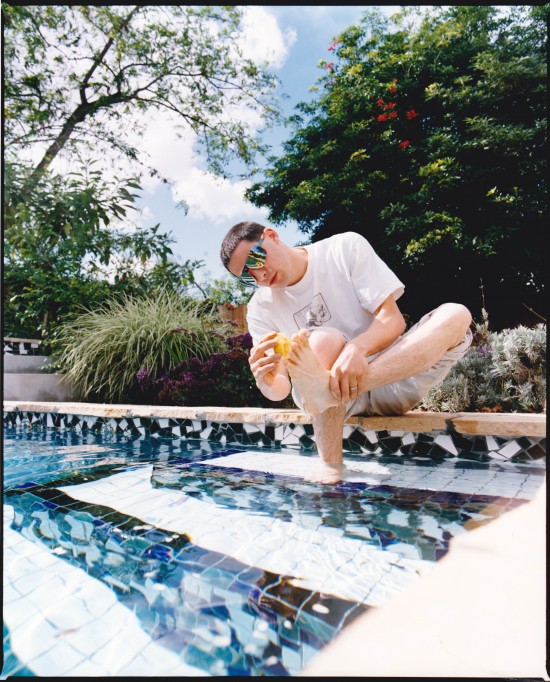
    APE: You already have your style here. It?s in that picture.

    Jake: I guess it?s a kind of very loose, not overly directed. You kind of work with them just to let their personality do the talking. And they were really funny guys. They were into it, just pissing around for an hour or two.

    APE: So, you just kind of fell into that style?

    Jake: I think, yes.

    APE: It just happened, there was nothing planned about it?

    Jake: In the beginning I would look at a book of photographs I liked the night before a shoot, going, what am I going to do, what am I going to do? But that didn?t really work on the day, as all my preconceived ideas went out the window. So I just think, not consciously, that I would go in and suss out the location, then meet and chat to who I was shooting and see where it went. But I talk too much and I?d start talking and kind of see what happens; try and get into a situation where something might happen.

    APE: You talk too much, that?s part of your style.

    Jake: That?s funny you should say that, because my wife just said, oh, you?re doing the interview today, don?t ramble.

    APE: [laughs]

    Jake: You know, I just talk and talk and talk.

    APE: Every single shoot?

    Jake: Yes, if they respond. [laughs]

    APE: What happens if they don?t?

    Jake: It?s harder. I mean, you can work in silence, but it?s easier if they respond or start talking back. But I remember reading a David Bailey quote where he said he maintained a constant stream of encouragement and I think I do try to do that.

    APE: I?ve never been on set with you, but now your pictures make a lot more sense now that you say that. Is that nervous energy, the talking?

    Jake: When I do a shoot, the hour before the shoot is the worst hour of my life. I don?t want to be there. I want to go home. I?ll do anything to be on the other side of it. So I think it?s partly nervous energy.

    Then suddenly you?re confronted with for example Robert De Niro. He?s walking into the room and you?ve got to do something to get the shot. I?ve shot him a couple of times. It?s intimidating.

    APE: He?s not a talkative guy?

    Jake: He?s not a very talkative guy.

    APE: You?re just talking to him the whole time?

    Jake: Talking at him. I?m trying to get something out of him. But what I?ve realized with he doesn?t want to hear how great of an actor he is. He knows how fucking good of an actor he is like all these guys. You don?t want to go in there ? although it?s difficult sometimes if you?re a fan ? and say, ?Oh my god. I love you.? But I think the bigger the star, the smaller the talk. Talk about the weather, or what movie you saw last night, or what you?re doing for the holidays.

    APE: You?ve done this for a long time but when you started, did you have some things in your head that you knew you were going to talk about? Or do you just read the newspaper and you know what?s going on?

    Jake: Sometimes it?s just current affairs. If they talked to the editor or stylist beforehand, you just gauge what they were talking about and what their level of interest is, how talkative they are. Often I ask the PR, ?What?s a good thing to talk about? What does he not want to talk about??

    I don?t overly research the people I?m shooting, but obviously I?ll read and find out something.

    It?s funny. Since I?ve had kids, I talk endlessly about them. I?m boring. I?m the fucking worst dad bore. I love talking about other people?s kids because it?s a human thing. It?s not about work.

    APE: So if they have kids, you?re talking about kids for hours?

    Jake: And then if they want to talk about their kids, I love to hear about what their kids do and we can compare notes.

    I say, ?What have you got?? And they say, ?I?ve got two girls.?

    ?How old are they??

    ?13 and 17.?

    I?m like, ?Oh my god. I?ve got two girls. They?re seven and ten.? And they?re like, ?Oh geez. You?re in trouble.?

    If they?re willing to be personal, great. If they?re not?

    APE: Does that make better pictures or does it matter?

    Jake: I don?t think it really matters. I think it makes the session easier. I shot a big job last week for Sony, and I was editing with the client and he said to me that he noticed as the shoot went on, I just wear them down. You just keep going and talking until they drop and give in, which I had never analyzed as a reality.

    APE: That always happens? Do you get your best pictures after you?ve worn them down? They don?t happen at the beginning of the shoot? Is that pretty common with you?

    Jake: Sometimes at the beginning of the shoot and sometimes it?s five minutes from the end of the shoot. I haven?t really looked at the flow. But sometimes the shoot is only minutes long, so there?s not much time.

    APE: That was just something that occurred to you recently?

    Jake: It occurred to me that it was a possibility, but I hadn?t really thought about it until this guy said it last week. Maybe it?s true. I don?t know.

    APE: We?ve jumped ahead to your style which I really like. I want to talk more about it, but how do you get from London to here?

    Jake: I started coming out here to work and then I had two friends who lived in the West Village. They?re from England. They?d gone out to get jobs in New York and so I started coming out and staying with them to do appointments, to try and get work here with varying degrees of success because it was really hard as a foreigner. You come into this new market and you?re all excited. ?I?m going to get loads of work.? And of course you go back to London and they forget about you immediately. This was in 1995. It was pre-Internet and pre-email.

    I think the big break was when I had been coming and going for a year or two and then Matt Berman and John Kennedy Jr. started ?George? magazine. Matt Berman was his creative director. He hired Bridget Cox, who was his photo director and then Matt and Bridget picked up every English magazine. They went through The Face, ID and Arena with a fine toothed comb and picked the photographers from England that they wanted to work with.

    APE: Why would they pick only photographers in England?

    Jake: I don?t know. It was just a thing. I think they thought it would maybe bring in a sensibility and those magazines were at their peak. They used American photographers as well. Of course there are really good photographers here, but they decided to get a little school of London based photographers they?d fly out to shoot.

    APE: They?d fly you into the States?

    Jake: It was incredible. Before the magazine launched, Matt called me up and said, ?Do you want to come out and shoot for us?? He flew me out. I stayed with friends. In fact, they may have put me in a hotel for the week. I hung out with Matt in his office and we?d shoot the shit, chat about photography, design, art. He?s a great guy.

    And then he sent me to Colorado to shoot a senator. I shot some portraits in New York and then I flew back to London. And then he?d fly me out again. I did Kofi Annan. Newt Gingrich with a lion. I did a bunch of people. They did these themed issues. I did like the ten top men in politics or something like that. They?d fly me all over the country and it was a real education.

    So suddenly I was getting a ton of shoots here and I was getting a bit more exposure. And gradually over the period from the beginning of 1996 to 1999, I came here more and more until I was here for three or four months a year. I was picking up interesting portraits in London for magazines like W, and I got a great break when Kathy Ryan at The New York Times Magazine hired me to shoot a cover of Tom Hanks and Ben Affleck. I shot a series of covers for them from 1998 onwards. It was starting to get stupid because I was constantly away. I would literally get home, get a phone call and get back on an airplane. It wasn?t making my personal life particularly easy.

    My wife and I had been talking about moving to New York so in the middle of 1998 we thought, ?Fuck it. We?ll move to New York.? She?s a really talented designer and got a job working for The Gap. We got married on March 27, 1999. We went to Saint Lucia for a week for our honeymoon we flew back on the third of April and on the fourth of April, we moved to New York.

    APE: Big life change.

    Jake: We literally left everything.

    APE: You felt you needed to move to New York to have a successful career?

    Jake: I think my experience in being here and then going back and not getting any phone calls was like that Andy Warhol saying, ?Success is a job in New York.? And I thought that was where it was at and if I wanted to shoot big names for big clients that is where I needed to be. I wasn?t a fashion photographer. I wasn?t a product photographer or a car photographer and in England that?s a big market. I wasn?t particularly technical and a lot of the advertising imagery in the UK was very precise and that?s not me. I thought there was a lot of personality based stuff for me to shoot here.

    And it was financial. My first big job in New York was in the end of 1998. I got a big job for IBM where we shot here, in London and in Tokyo. It was just before we moved. I got that ad job which paid a lot.

    APE: So you saw that most of your potential clients were here.

    Jake: It was a leap of faith. It was partly financial, but partly opportunity. All the celebs are here. If you shot a celeb in London, it was in a hotel room for 20 minutes on a press junket.

    One of the first jobs I did here after moving and I suddenly thought, ?OK. This is working out.? It was for Nancy Iacoi at ?Premiere? who called me and asked me to shoot Johnny Depp for a cover, so we flew out to Frank Lloyd Wright House in LA. Now, that?s a shoot. [laughs]

    APE: That?s an amazing shoot.

    Jake: It?s not 20 minutes tucked in somewhere. It was amazing to suddenly be here doing all that stuff.

    APE: And you were shooting big time editorials, shooting for tons of magazines?

    Jake: I was shooting for ?The New York Times Magazine?, ?Premiere,? ?Newsweek,? ?Esquire,? ?Entertainment Weekly?, ?Details? a lot of editorial.

    APE: I want to get into the promo stuff and the custom portfolio books because these are really interesting. Let?s get into these books. When did you first start making the books?

    Jake: ?97 was the first one.

    APE: Describe the process. Why did you start making them like this with the color photocopies?

    Jake: When I started working for foreign magazines from London, it was pre-email, pre-Internet. You would FedEx off the edit, so I was cutting out these pictures realizing that as I didn?t have two sets of contacts necessarily, that I would never see them again, and to have a record of what the hell I had sent them I made color copies and they were sitting around in a pile.

    Then I said, ?Hmm. I?ll stick them in a book.? So I started cutting them out and making these collages and arrangements which I think because I?d been to art school and done a lot of painting, drawing stuff that it was second nature to have a sketch book. It was kind of the first photographic manifestation of a sketchbook.

    And within a few weeks, I started to get a thick little set of pictures. There were pages and pages of this stuff. I had always been frustrated with my portfolios because they were one or two prints from each sessions and it didn?t really reflect the shoot.

    APE: You wanted to show the whole take?

    Jake: Yes because I was confident at this point. It was following off my conversation with Grant Scott who said, ?Do you want to be a working photographer or a good photographer?? He showed me a shoot that one of the guys who worked he?d with, I can?t remember who it was, had done with Antonio Banderas and this guy had everything. He had close ups, wide shots, back and white, color, different outfits.

    And he said, ?How long do you think they had to do this shoot?? I said, ?It looks like all day.? And he said, ?No. They had two hours.? He said, ?You?ve got to cover more than one shot because what if you submit a color headshot and the magazine has already got 20 color headshots in this issue and they want a black and white wide shot? You?ve got to think about that.?

    And I had never considered it. I was too dumb. This was early on in my career. I was like, ?Shit. He?s absolutely right.? So I started shooting around and trying really to explore and shoot how he told me to, for him particularly. So I had all these shots that never saw the light of day.

    APE: And that is also a signature thing for you is how many setups you do.

    Jake: I guess it became that way just trying to give a variety.

    APE: And is part of that you just wearing them out? Or are you just trying to find something?

    Jake: It?s like, ?I?ve got that. Let?s do something different.? I?m always thinking that there?s a better shot here that I haven?t seen yet.

    APE: Back to the books.

    Jake: I?d put these together and suddenly it became a tool. Not just for reviewing the work but for getting work. Art directors seemed to respond very well to it. They loved to see the variety, to see the outtakes, to feel it?s something that?s personal, which it is.

    APE: It?s very unusual. I don?t think I know anyone who does it this way but again it just fits with your personality so well. And you did it out of necessity.

    Jake: Yes. I had wound up the first one and then I think ? ?We need two of these,? so I?d do two. It got to a point where I think on one round we did six of them. It took weeks. It?s really labor intensive.

    APE: And you?ve done one of these every year.

    Jake: Yeah, pretty much.

    APE: It?s amazing. That?s amazing just to have that record of your career.

    Jake: It?s a good review. It?s good to look back just to try and find stuff. I?ve got a client that I am about to shoot for, and they?re looking for pictures of night views of cities so I just went through them last night and pulled out a couple. It?s good to review and find stuff.

    APE: Night views of cities?

    Jake: Yeah, it?s for a vodka client.

    APE: Oh, to go in with your other shots?

    Jake: Yes, so that we don?t have to shoot it because we?ve only got two days to shoot this thing.

    APE: What about as far as promos and stuff? Did you just do the normal kind of promo cards?

    Jake: Yeah, I did promo cards, although I think they?re of somewhat limited value. But, you?d hope to go into someone?s office and see one pinned up on the wall.

    APE: [laughs]

    Jake: It was brutal back then. It?s so much easier now to get pictures out there because you either have a website, blog, or send them in an email and people are hopefully interested to get them.

    APE: Right. Yeah, let?s talk about that next, that evolution into The Daily Chessum. It makes a lot more sense to me now, meeting you and seeing and remembering the proliferation of images that you produce. Doing something daily, that makes a lot of sense now.

    Jake: There are a hundred pages in each of these books. So that became an end in itself and a promotional tool that came out of nowhere and seemed to pay off. But then getting a website took a while and once you?ve got it up and running it?s hard to update, it takes a real commitment. I was talking to my agent and she was saying ?Maybe you should do a blog.? I thought ?Yeah, that?s great, but no writing.?

    APE: [laughs]

    Jake: I?m not disparaging any blogs where people write about their experiences, but I didn?t want to do that. I didn?t want to demystify the process. There?s a lot of stuff out there that you shouldn?t tell anybody. You know what I mean?

    APE: Yeah. If you want to reach photo editors and art directors and art buyers, then you need to be showing pictures and not talking about the process.

    Jake: Yeah as a consumer of some of those blogs, it?s interesting to read that stuff because it creates a kind of kinship and it?s good to know you?re not the only one dealing with that crap. But yeah, I don?t want to divulge that information. I just wanted to put pictures out there regularly to show what I was up to. It?s easy to do, look at, immediate. It?s my visual diary.

    APE: It?s just another promotional vehicle.

    Jake: Yes, and I was really happy that Tumblr sent me a little email saying, oh, we love your blog, we want to put it on our spotlight page. Which overnight, I went from, 500 followers to like, 3,000, and then the next month it was 5,000, and up to 22,000 followers.

    APE: I talked to you a year or longer ago about it, and you were saying ?I don?t know where this is going to go, but I feel like I need to participate.?

    Jake: Yes.

    APE: And you said you?re making a mistake not trying some of these new tools out.

    Jake; True, and I?m not an innovator in that sense because I waited so long to jump on the blog bandwagon.

    APE: No, but you took the time to see all the other blogs and make a decision, how you wanted yours to work.

    Jake: Yes, and I thought, if you don?t update, you lose traffic so, I thought every day I?d put up one image, because putting up more would be a sheer burden to come up with more good pictures. Do you know what I mean? I didn?t want to dip into the archive too much. I wanted it to be something current. I want it to reflect what I was up to within that time frame. And obviously, it?s a kind of a cheat, because when you know you?re going to be busy, I queue up my 10 ahead or sometimes 20 ahead if I know I?m going to be crazed.

    APE: And it?ll do it automatically.

    Jake: Yes, it updates once a day, every day.

    APE: Right, that?s perfect.

    Jake: And then yesterday I got a bunch of PDFs of something that just came out, so I pushed everything back a few days and dropped those in to come in sooner.

    APE: And, the other thing that you told me was with your shoots there?s all these outtakes that don?t make it in the magazine.

    Jake: You have to be careful with that because you can diminish the value of the outtakes. Or upset a publicist. Clients want to pay for exclusives.

    APE: Well, I think it?s brilliant.

    Jake: Thanks. But, yes, it?s just a really cool way of making you work as well and making you take pictures. If you haven?t shot a job for a couple of days and you need to post, then it?s time to go out and shoot some pictures.

    APE: I want to talk just really quick about the transition to digital. Obviously, you?re not shooting very much film anymore.

    Jake: No.

    APE: But then you were saying how much you like digital.

    Jake: Yes, I?m psyched about it.

    APE: When did you finally embrace?

    Jake: I haven?t shot an ad job on film for five years. And I haven?t seen a reason why I would have to. So in the last four years.

    APE: Once you embraced it you felt like, ?This is amazing.?

    Jake: It?s like a revelation. I?d read yesterday some photographer who went fully digital in 2001. I went, ?Fucking hell. That was pretty early to really go 100 percent digital.?

    APE: Some people don?t love the film and the printing. They never got into that. Obviously all that time in the darkroom, you love that process.

    Jake: Years of printing black and white and processing film. Seeing it, holding it up in the darkroom for the first time. There?s a huge thrill. There always was in seeing the print come up, and actually going through the craft of washing it, drying it. All that stuff.

    Letting that go took a while. But I think I went through a transitional period. I had a darkroom in London, but I never had one here, and as I got busier I let it go. I was also shooting a lot of color and I never printed my own color. Plus the printers I used were better at it than I was. But I?ll admit I was one of those sanctimonious douchebags back in the day who was like, ?Oh my God, they never print. How can you call yourself a photographer? How disgusting.? When I had the kids, I didn?t want to spend a night in the darkroom. I wanted to go home.

    APE: What was the revelation once you really got into it?

    Jake: I had let control go to an extent with the printing and retouching when I was all film. But when I started shooting digital I felt I claimed it back. Getting the images to where I wanted them, even something as simple as making something black and white, felt like giving me a creative outlet within the medium that I kind of lost track of. I?d let that go for a bit and it was a revelation to get it back. Do you know what I mean?

    APE: Yeah. I think that completes the circle. Thanks for your time.

    Jake: No problem.
    by A Photo Editor on October 22, 2012 ? 7 comments


    Source: http://www.aphotoeditor.com/2012/10/22/jake-chessum-interview/

    aspirin aspirin 21 jump street illinois primary results acapulco mexico hines ward alex smith